Your Skin Is Reacting to Something That Happened 48 Hours Ago
Why the gut-skin connection runs on a delay — and what that changes about how you read your own skin.

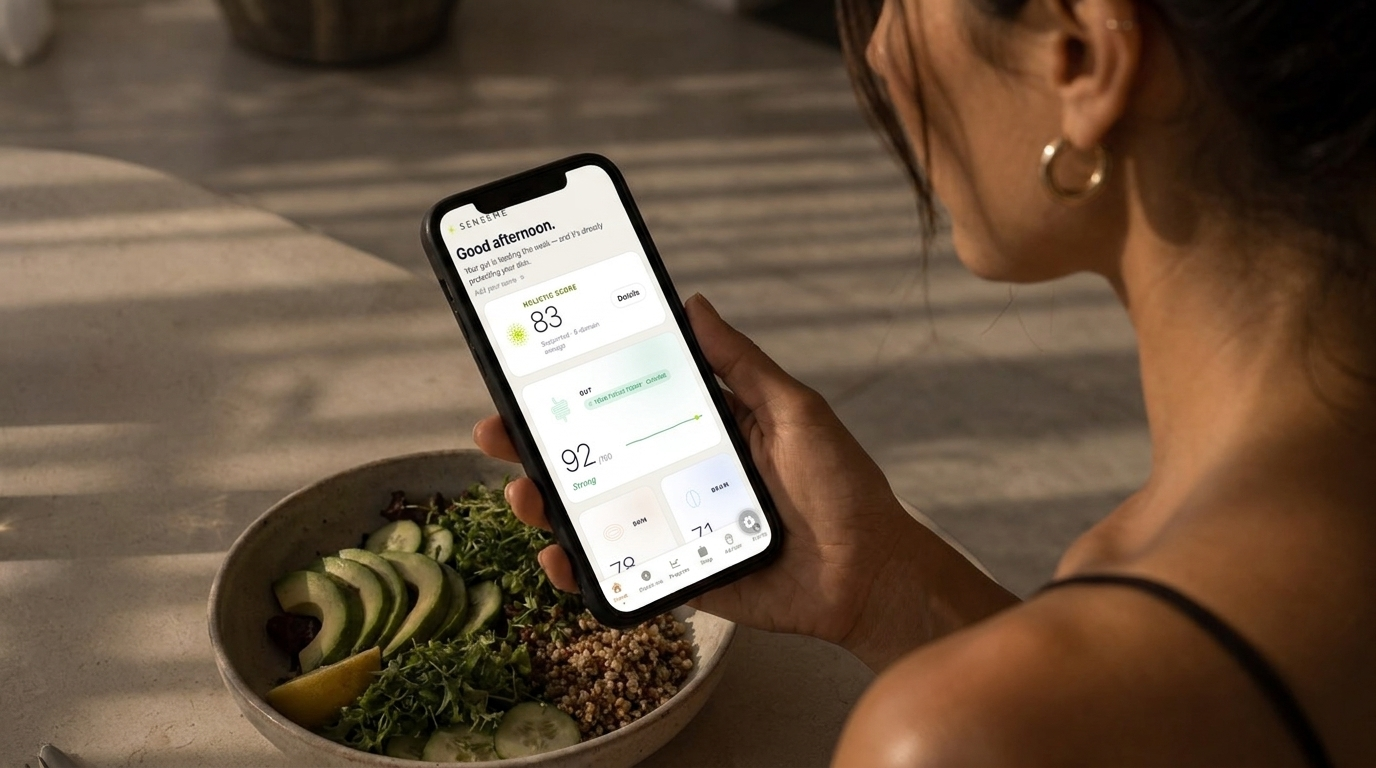
- When gut bacteria are disrupted, skin responds 48–72 hours later — not the same day.
- The delay occurs because gut-derived inflammatory signals travel through the bloodstream before triggering visible skin changes.
- The four events most likely to precede skin changes: high ultra-processed food intake, antibiotic use, sustained stress, and excess alcohol.
- Because of the lag, most people connect the wrong event to their skin outcome — or connect nothing at all.
- Tracking skin with a consistent 48-hour lookback window changes what you can see and act on.
When gut microbiome balance is disrupted — by stress, a run of ultra-processed food, antibiotics, or illness — the skin typically responds not on the same day, but 48 to 72 hours later. This is the gut-skin lag. It is the reason most people cannot connect their habits to their skin outcomes: by the time the skin reacts, the gut event is in the past, and the brain reaches for the nearest explanation — the new moisturizer, the weather, a bad night of sleep. The actual cause happened two days earlier.
I have spent 17 years working in skin-gut-brain health, and this is the pattern I have watched repeat more than anything else. The skin is not a real-time readout. It is a delayed readout. And that delay is the thing nobody explains when they talk about the gut-skin axis — because without it, the connection sounds abstract. With it, it becomes something you can actually act on.
What Is the Gut-Skin Lag?
The gut-skin axis is the bidirectional communication network between the gastrointestinal tract and the skin. It operates through immune signals, microbial metabolites, and neuroendocrine pathways. Research has consistently linked changes in gut microbiome composition to inflammatory skin conditions including acne, eczema, psoriasis, and rosacea. Human study1,2
The lag is not a hypothesis. It is a structural feature of how this system works. The gut communicates with the skin indirectly — through the bloodstream, through lymphatic signaling, and through shared immune pathways. None of these are instantaneous. Each step in the cascade takes time. The cumulative delay is what we see as the 48–72 hour window.
In some individuals this lag is shorter — around 36 hours. In others it extends to 96. But it is almost never same-day, and it is almost never random.
Why Does the Delay Happen?
The mechanism runs through three distinct stages, each of which adds time.
Stage 1: The gut event
A disruption to the gut microbiome occurs. This could be a two-day period of high-sugar, ultra-processed food — which selectively feeds pro-inflammatory bacteria while starving the bacteria that produce short-chain fatty acids (SCFAs). Human study3 It could be antibiotic use, which can reduce microbiome diversity by 25–90% within 24–48 hours of the first dose. Human study4 Or sustained psychological stress — which directly alters gut motility and microbiome composition via the gut-brain axis, and which carries its own two-day lag to the skin. Mechanistic Or alcohol intake, which increases intestinal permeability measurably within hours. Human study5
Stage 2: The systemic signal
Disruption leads to two interrelated changes. First, SCFA production drops — particularly butyrate, which has documented anti-inflammatory effects throughout the body. Human study6 Second, intestinal permeability increases, allowing bacterial endotoxins — including lipopolysaccharides (LPS) — to enter systemic circulation. This triggers a measurable inflammatory cascade: elevated IL-6, IL-1β, and TNF-α. Human study7
Stage 3: The skin response
Circulating cytokines reach the skin and activate resident immune cells — mast cells, keratinocytes, dermal macrophages. Mechanistic Their response — local inflammation — is what produces visible changes: redness, congestion, new breakouts, increased sensitivity. Human study, limited8 The full cascade, from the gut event to visible skin change, takes time. That time is the lag.
The Four Gut Events That Most Reliably Precede Skin Changes
Not every gut disruption produces a visible skin response. The events most consistently linked to skin changes — based on the mechanistic literature and clinical observation across 17 years in this field — are the following.
| Gut event | Primary mechanism | Typical lag | Evidence level |
|---|---|---|---|
| High ultra-processed / high-sugar diet (2+ days) | Dysbiosis, reduced SCFA production, raised inflammatory cytokines | 48–72 hrs | Human study |
| Antibiotic or NSAID use | Rapid microbiome diversity reduction, barrier disruption | 36–72 hrs | Human study |
| Sustained psychological stress (2+ days) | HPA axis activation → gut motility changes → dysbiosis → systemic inflammation | 48–96 hrs | Mechanistic + Human study, limited |
| Alcohol ≥2 drinks/day for 2+ consecutive days | Intestinal permeability increase, LPS translocation | 48–72 hrs | Human study |
What 17 Years in Skin-Gut Health Has Shown Me
The thing is — I did not build SenseMe because I read about the gut-skin axis in a review paper. I built it because I watched people try to manage their skin for years without making progress, not because they lacked information but because they were always looking at the wrong time window.
The conventional approach to skin is reactive and same-day: a flare appears, you reach for a topical. You wake up with congestion, you review last night's dinner. But if the gut-skin lag is real — and the mechanisms are well-established — then the relevant event was not last night. It was the day before that, or the one before that.
What I have consistently seen, both through years of working in skin-gut nutrition and in SenseMe's early longitudinal monitoring, is that the people who make genuine progress on their skin are the ones who stop chasing the most recent event and start tracking at the system level. They look backward consistently. They connect events across a two-day window instead of a two-hour one. Caveat — SenseMe's observational data is proprietary and pre-publication. The ~48H median lag is based on internal signal analysis, not a completed peer-reviewed trial. Treat as hypothesis-generating until peer-reviewed publication.
Why Your Skincare Routine Is Treating the Wrong Window
This is the uncomfortable part. Most topical skincare — including the most evidence-backed, most expensive products — addresses the skin at the output end of a process that started in the gut two days earlier. The topical is not wrong. But it is incomplete. It treats the symptom while the upstream cause continues — and over years, that same upstream inflammatory load is what drives collagen breakdown and visible skin aging.
There are three points where the gut-skin inflammatory cascade can be interrupted:
- The upstream gut event — preventing the dysbiosis trigger in the first place through diet, reduced antibiotic exposure, and stress management.
- Gut barrier integrity — reducing intestinal permeability so fewer LPS and inflammatory signals enter circulation. Human study, limited
- The skin immune response — topical anti-inflammatories, barrier-supporting actives — which is where almost all skincare sits.
Points 1 and 2 remain invisible to most people because they require connecting events separated by two days. Without that connection, upstream intervention feels optional — abstract diet advice, not skincare. The lag is why gut health has not fully landed as a mainstream skin intervention: the feedback loop is too slow for the brain to wire naturally.
Using the Lag to Your Advantage
The lag is not only a problem. It is also a window. If the skin responds to gut events 48–72 hours later, you can:
- Identify your personal trigger events by looking backward 48–72 hours from every skin change, consistently, over at least four weeks.
- Understand why gut-focused interventions — dietary changes, probiotic strains, gut barrier support — take weeks rather than days to show results: they need to stabilize the upstream signal before the skin stops reacting.
- Stop attributing skin changes to the most recent event and start attributing them to the right event — which changes what you actually decide to change.
The challenge is that consistent two-day lookback is nearly impossible to do manually. Humans are not built to connect events separated by 48 hours — we instinctively pair the most recent event with the current outcome. This is where continuous biological monitoring has an advantage that a diary or a symptom app does not: it tracks the signal over time and surfaces the pattern without requiring you to remember and connect across a two-day gap.
That is what SenseMe is built to do. Not to tell you what to eat. Not to replace your dermatologist. But to make the lag visible — so you can see the pattern in your own biology and act on the right things.
Common Questions


- Salem I, Ramser A, Isham N, Ghannoum MA. The Gut Microbiome as a Major Regulator of the Gut-Skin Axis. Front Microbiol. 2018;9:1459. doi:10.3389/fmicb.2018.01459. PMID 30042740.
- Bowe WP, Logan AC. Acne vulgaris, probiotics and the gut-brain-skin axis — back to the future? Gut Pathog. 2011;3(1):1. doi:10.1186/1757-4749-3-1. PMID 21338532.
- Sonnenburg JL, Bäckhed F. Diet-microbiota interactions as moderators of human metabolism. Nature. 2016;535(7610):56–64. doi:10.1038/nature18846. PMID 27383980.
- Jernberg C, Löfmark S, Edlund C, Jansson JK. Long-term ecological impacts of antibiotic administration on the human intestinal microbiota. ISME J. 2007;1(1):56–66. doi:10.1038/ismej.2007.3. PMID 18043614.
- Bishehsari F, Magno E, Shah G, et al. Alcohol and Gut-Derived Inflammation. Alcohol Res. 2017;38(2):163–171. PMID 28988574.
- Sivaprakasam S, Prasad PD, Singh N. Benefits of short-chain fatty acids and their receptors in inflammation and carcinogenesis. Pharmacol Ther. 2016;164:144–151. doi:10.1016/j.pharmthera.2016.04.007. PMID 27113407.
- Belkaid Y, Hand TW. Role of the microbiota in immunity and inflammation. Cell. 2014;157(1):121–141. doi:10.1016/j.cell.2014.03.011. PMID 24656480.
- De Luca F, Shoenfeld Y. The microbiome in autoimmune diseases. Clin Exp Immunol. 2019;195(1):74–85. doi:10.1111/cei.13158. PMID 30091458.