
What Astaxanthin Does to Aging Skin — From the Inside
A ketocarotenoid from microalgae with unusually potent antioxidant activity — and what the human evidence actually shows.


- Astaxanthin is a ketocarotenoid pigment produced by the microalgae Haematococcus pluvialis — the richest known natural source of this compound.
- It quenches singlet oxygen with substantially greater potency than vitamin C or E, and integrates directly into cell membranes to interrupt lipid peroxidation chain reactions.
- An 8-week randomised controlled trial found significant improvements in crow's feet wrinkle depth, age spot size, skin elasticity, and surface texture at 6 mg/day oral astaxanthin versus placebo.
- Oral astaxanthin may suppress UV-induced upregulation of matrix metalloproteinases — enzymes that degrade dermal collagen — by reaching the dermis through systemic circulation.
- The clinical evidence is biologically coherent but limited in volume; 6 mg/day with a fatty meal is the evidence-based reference dose, best understood as a complement to sunscreen — not a replacement for it.
Astaxanthin is a ketocarotenoid — a pigment in the same chemical family as beta-carotene and lycopene, but with structural features that make it considerably more active as an antioxidant. The red-orange compound is what gives salmon, shrimp, and flamingos their colour; these animals acquire it by consuming organisms that produce it, most notably the microalgae Haematococcus pluvialis. Researchers have been investigating whether oral supplementation with astaxanthin can influence how skin ages — not by applying something to the surface, but by altering the antioxidant environment inside the cells and matrix structures that hold skin together over decades.
What Astaxanthin Is and Where It Comes From
H. pluvialis is the richest known natural source of astaxanthin, accumulating the pigment at concentrations of up to 4% of its dry weight when subjected to oxidative stress — a survival mechanism the algae triggers in response to intense UV radiation, nutrient deprivation, or high salinity. Mechanistic3 The astaxanthin acts as a molecular shield, absorbing and neutralising the energy of reactive oxygen species before they can damage the algae's cellular machinery. Most supplemental astaxanthin is extracted and standardised from this algae source.
One structural distinction worth noting upfront: unlike beta-carotene, astaxanthin cannot be enzymatically converted to vitamin A in the body. This means it does not carry the toxicity risk associated with high-dose preformed vitamin A or synthetic retinoids — a property that has allowed researchers to explore higher and longer supplementation windows with relative confidence about safety. Human study4
How It Works in Skin — Antioxidant and Anti-Inflammatory Mechanisms
The primary mechanism through which astaxanthin may influence skin aging is antioxidant activity — specifically, its capacity to quench singlet oxygen and neutralise reactive oxygen species (ROS) generated by UV exposure. Singlet oxygen is a particularly damaging species produced in skin when UV photons interact with endogenous photosensitisers; it can oxidise lipids, proteins, and DNA, initiating the cascade of molecular damage that ultimately registers on the surface as wrinkles, pigmentation changes, and loss of elasticity. Mechanistic
What makes astaxanthin distinctive among carotenoids is its molecular geometry. It spans the full width of the cell membrane, with polar end groups extending beyond the lipid bilayer on both sides. This allows it to anchor within the membrane structure and interrupt lipid peroxidation chain reactions that would otherwise propagate laterally through the bilayer — a mode of action qualitatively different from purely water-soluble antioxidants like vitamin C, which operate in the aqueous phase. Mechanistic
In singlet oxygen quenching, in vitro comparisons suggest astaxanthin shows approximately 6,000 times the activity of vitamin C and roughly 550 times that of vitamin E. In vitro2 These figures come from assays and should not be extrapolated directly to equivalent clinical benefit — bioavailability, tissue distribution, and the specific oxidative environment in living skin are far more complex. That said, the mechanistic case for astaxanthin as a membrane-active, singlet-oxygen-quenching antioxidant is well-established in the biochemical literature.
A second mechanism involves matrix metalloproteinases (MMPs) — a family of enzymes that degrade collagen and elastin fibres within the dermis. Cumulative UV radiation upregulates MMP activity, and this enzymatic collagen breakdown is one of the principal biochemical pathways through which sun exposure leads to visible photoaging over time. Review5 Preclinical data suggest astaxanthin can suppress UV-induced MMP upregulation, potentially slowing the pace at which dermal collagen is degraded. This pathway is biologically plausible and consistent with the compound's antioxidant profile; direct human evidence isolating this specific mechanism remains limited, but it forms part of the mechanistic rationale for the clinical research below. Mechanistic
Unlike some antioxidants that struggle to reach deeper skin layers via topical application, an orally administered compound that reaches systemic circulation can, in principle, be delivered to dermal fibroblasts and extracellular matrix structures through the vascular network. Astaxanthin is fat-soluble and has been shown to cross the blood-brain barrier in animal models, indicating meaningful tissue distribution. Mechanistic
What the Clinical Trial Showed
The most directly relevant human trial was published in the Journal of Clinical Biochemistry and Nutrition in 2017 by Tominaga and colleagues. The study enrolled 30 women and compared oral astaxanthin at 6 mg/day — sourced from H. pluvialis microalgae — against placebo over 8 weeks, with skin assessments at baseline, 4 weeks, and 8 weeks. RCT1
Against placebo, the oral astaxanthin group showed statistically significant improvements in four measured outcomes:
- Crow's feet wrinkle depth — quantified by skin replica analysis using a profilometry system
- Age spot size — assessed by chromameter measurement of pigmented areas
- Skin elasticity — measured at the forearm using a cutometer
- Skin texture — evaluated by surface topography analysis
The trial also included a combined-treatment arm in which participants took oral astaxanthin and applied a topical astaxanthin formulation. This combined group showed additive improvements beyond those seen with oral supplementation alone — suggesting that systemic and surface-level delivery may target complementary processes rather than simply doubling up on the same mechanism. Skin hydration also trended toward improvement but did not reach statistical significance in all comparisons. RCT, small sample1
The Tominaga 2017 trial was conducted with a commercial astaxanthin preparation and was partly industry-affiliated. The sample size was small — 30 women — and independent large-scale replication of these specific effect sizes in diverse populations has not been published. The mechanistic evidence for ROS scavenging is robust and independently derived; the magnitude of clinical improvement in wrinkle depth and age spots should be interpreted with appropriate caution until confirmed in larger, independently funded trials. Caveat — small, industry-affiliated RCT; treat effect sizes as directionally interesting, not definitive
Oral vs Topical Antioxidants — What Is Different About Oral?
Topical antioxidants — vitamin C serum, vitamin E, niacinamide — are well-established in evidence-based skin care. They are applied directly to the target tissue, absorption does not depend on gastrointestinal factors, and their stability and tissue penetration can be precisely engineered through formulation chemistry. For many applications, topical delivery is more efficient than systemic.
Oral astaxanthin works by a different route. When ingested, it is absorbed in the small intestine — bioavailability improves substantially when taken with a meal containing fat, consistent with its lipophilic nature — transported in the bloodstream as part of lipoprotein particles, and delivered systemically to tissues including the dermis. The dermis, which sits below the epidermis and houses the collagen-producing fibroblasts and the vascular network, is less accessible to topically applied products that must penetrate through the stratum corneum and epidermis first. Mechanistic
The potential advantage of an oral route is systemic distribution: a circulating antioxidant may influence processes throughout the entire skin surface and in tissues not easily reached by a cream, including deeper dermal structures. This is not a claim that oral astaxanthin is definitively superior to topical antioxidants — the evidence base for topical L-ascorbic acid alone is substantially larger and more replication-rich — but it represents a mechanistically distinct mode of delivery that may be complementary rather than redundant. Caveat — direct head-to-head comparisons are limited
The Tominaga trial's combined arm, which outperformed the oral-only group on several measures, supports this complementary framing. Taking an oral antioxidant and using a topical one appears to engage different pathways; the effects were additive rather than duplicative in this small study. RCT, limited scale1
Honest Limits
The evidence for oral astaxanthin and skin aging is biologically coherent and backed by one controlled human trial, but five honest caveats apply before drawing firm conclusions:
- Sample size. Thirty participants is a small sample for skin-aging research, where inter-individual variation in baseline skin quality, sun exposure history, diet, and hormonal status is substantial. The findings are directionally interesting but should be considered hypothesis-generating until replicated in larger independent cohorts.
- Industry affiliation. The 2017 trial was partly conducted with commercial involvement. This is not uncommon in supplement research — it does not invalidate the data or indicate misconduct — but it is a standard reason for calibrating confidence in effect sizes downward until independent replication exists.
- Duration. Eight weeks is a relatively short window for outcomes in skin biology. Collagen remodelling, fibroblast turnover, and pigmentation regulation are slow processes typically measured over months to years. What an 8-week trial captures may not fully represent the trajectory of longer-term supplementation.
- Population specificity. The trial enrolled Japanese women. Photoaging patterns, baseline skin characteristics, dietary antioxidant intake, and carotenoid metabolism can vary by Fitzpatrick skin type and population. Generalisability to diverse groups has not been established.
- Mechanism vs outcome. The mechanistic case — singlet oxygen quenching, membrane integration, MMP suppression — is strong and supported by independent biochemical research. A compelling mechanism does not automatically produce clinically meaningful effects in humans at a given dose. The clinical evidence, while encouraging, remains limited in volume.
Where It Fits Alongside Sunscreen and Sleep
If you are already wearing broad-spectrum SPF 30 or higher daily and consistently, the marginal benefit of any supplemental antioxidant — including astaxanthin — is likely modest in absolute terms. Sunscreen remains the highest-evidence, highest-impact intervention for reducing cumulative UV-induced photoaging. Prescription tretinoin and, to a lesser degree, OTC retinol have the deepest clinical evidence base for remodelling established photoaging at the cellular level.
Where oral astaxanthin may have a complementary role is within a broader skin-health system — contributing to cellular antioxidant capacity from within, particularly if dietary intake of carotenoids and polyphenols is otherwise low, or if lifestyle factors create higher-than-average oxidative load: high-altitude UV exposure, significant time outdoors, air pollution, or smoking history.
Sleep is worth naming explicitly here. Dermal repair — collagen synthesis, barrier restoration, inflammatory resolution — peaks during sleep, particularly in the deeper sleep stages. Chronic sleep restriction is associated with measurable impairment of skin barrier function and accelerated appearance of aging in well-designed observational work. No oral supplement substitutes for the hours during which skin conducts its most substantive biological repair.
The honest framing for astaxanthin: a biologically plausible, low-risk addition to a skin-health strategy that is already anchored in sunscreen, adequate sleep, a diet broadly rich in antioxidants and carotenoids, and — where appropriate — evidence-based topical actives. Not a replacement for any of those, but a potentially coherent complement to them, particularly via the oral route's access to deeper skin structures. The 6 mg/day dose used in the Tominaga trial, taken with a fat-containing meal, represents the available evidence-based reference point.
Seeing Skin's Photoaging Load
Astaxanthin's core argument is that oxidative load — driven by UV, inflammation, and systemic stress — accumulates in the dermis long before it registers on the surface. The same dynamic plays out in the biological signals that continuous monitoring can surface. Oxidative stress does not confine itself to skin; it is a systemic condition that leaves signatures across multiple physiological domains simultaneously.
The Sense Band reads two autonomic proxies that are linked to systemic oxidative and inflammatory load: electrodermal activity (EDA) and heart rate variability (HRV). EDA reflects sympathetic nervous system activation — the same axis that amplifies cortisol and suppresses antioxidant defences during periods of UV stress, poor sleep, or high inflammatory burden. HRV reflects autonomic recovery; depressed HRV is consistently associated with elevated inflammatory markers in well-designed human studies, and UV-heavy days reliably shift it downward in people with sun-sensitive systems. Neither signal is a direct measure of skin oxidative stress, but both can contribute to a pattern that may reflect when the systemic environment is more or less hospitable to skin repair. Caveat — EDA and HRV are autonomic proxies, not direct skin biomarkers; the link to dermal oxidative load is associative
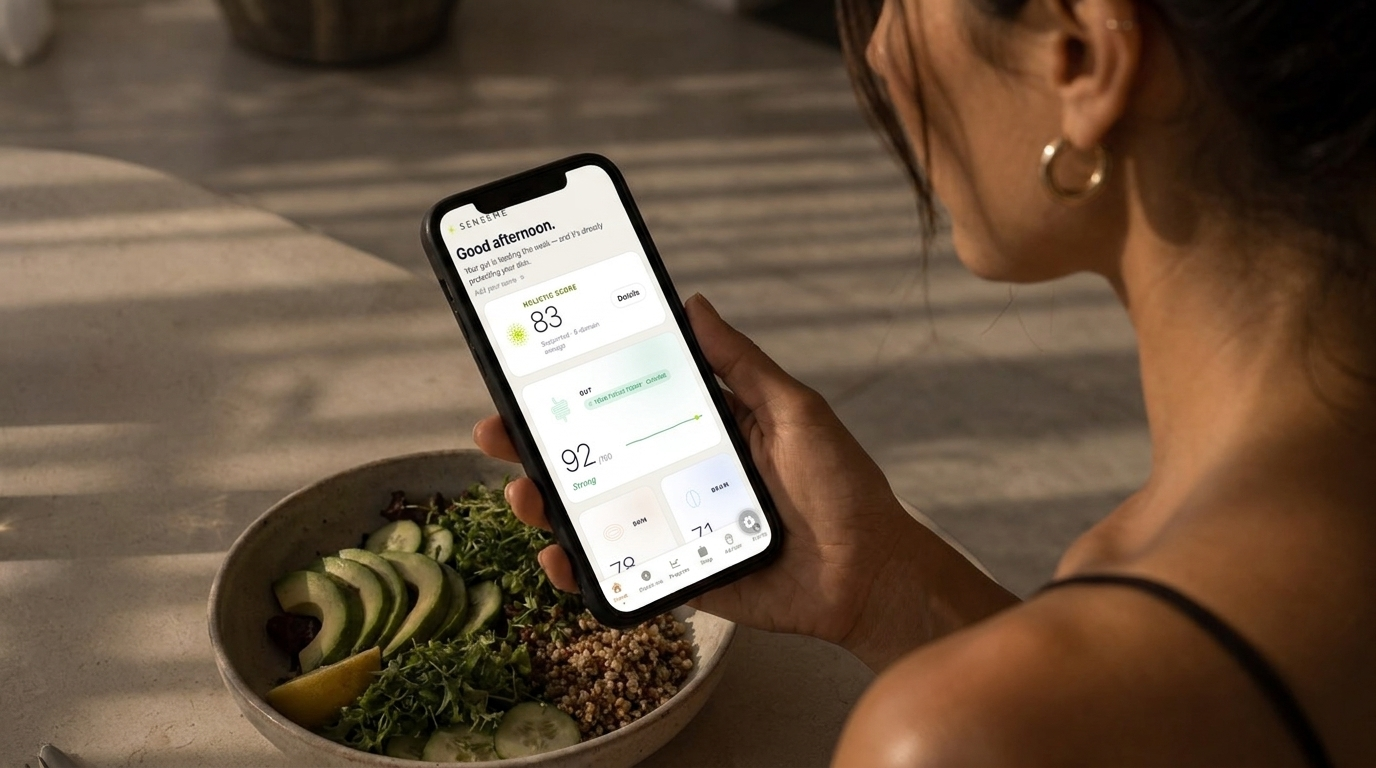
In the SenseMe app, the Skin domain score is built from multiple contributing signals — including sleep quality, recovery, and cross-domain lag patterns. When oxidative and inflammatory load is elevated systemically, the Skin score may begin to shift before visible skin changes appear; the gap between internal signal and surface expression is a version of the same lag dynamic at work in the gut-skin relationship. The Recovery score tracks how effectively the body is clearing accumulated stress — which, at a systemic level, is the same environment in which dermal antioxidant defences are either being replenished or depleted. A sustained dip in Recovery that precedes a skin change by several days is a cross-domain lag worth noticing.
Astaxanthin's mechanism — reducing the ROS burden that UV and inflammatory processes generate in skin cells — is a molecular-level intervention on the same system that the Sense Band is monitoring from the outside. The supplement may support the antioxidant environment in which skin repair occurs; the wearable can help surface when that environment is under pressure. Neither replaces the other. But understanding that skin photoaging is a systemic process — not just a surface event — is the context that makes both more useful. The SenseMe app's cross-domain view is designed to show exactly that kind of upstream signal: UV stress often appears first in Recovery or in autonomic data before it becomes visible as a skin change days later.
Common Questions


- Tominaga K, Hongo N, Karato M, Yamashita E. Protective effects of astaxanthin on skin deterioration. J Clin Biochem Nutr. 2017;61(1):33–39. doi:10.3164/jcbn.17-35. PMID 28751807.
- Nishida Y, Yamashita E, Miki W. Quenching activities of common hydrophilic and lipophilic antioxidants against singlet oxygen using chemiluminescence detection system. Carotenoid Sci. 2007;11:16–20.
- Lorenz RT, Cysewski GR. Commercial potential for Haematococcus microalgae as a natural source of astaxanthin. Trends Biotechnol. 2000;18(4):160–167. doi:10.1016/S0167-7799(00)01433-6.
- Dose-response and safety data synthesised from multiple human supplementation studies at 4–12 mg/day astaxanthin, various authors and journals, 2014–2022. Source characterisation covers carotenodermia incidence at higher doses and absence of vitamin A toxicity risk across reviewed literature.
- Fisher GJ, Kang S, Varani J, et al. Mechanisms of photoaging and chronological skin aging. Arch Dermatol. 2002;138(11):1462–1470. doi:10.1001/archderm.138.11.1462. PMID 12437446.