
Livaux Kiwifruit Powder and the Gut Microbiome: What the Human Evidence Shows
One gold kiwifruit preparation, one key gut bacterium, and what a randomised trial found — set in the context of the gut-skin axis.

- Gold kiwifruit (sold as Livaux) may act as a precision prebiotic, selectively increasing Faecalibacterium prausnitzii — unlike inulin, which broadly enriches Bifidobacterium spp.
- A randomised controlled trial found Livaux at 300–600 mg per day was associated with meaningful increases in F. prausnitzii in people with functional constipation, alongside improvements in digestive comfort.
- F. prausnitzii is one of the gut's primary producers of butyrate — a short-chain fatty acid critical for colon cell energy, gut barrier integrity, and anti-inflammatory signalling.
- A healthier gut barrier may reduce translocation of bacterial endotoxins (LPS) into the bloodstream, connecting gut microbiome health to skin and systemic inflammation.
- The evidence is promising but rests on one published RCT with manufacturer involvement; independent replication is needed before strong claims are warranted.
Of the hundreds of bacterial species inhabiting the human colon, Faecalibacterium prausnitzii is one of the most studied — not because it is unusual, but because it is a barometer. In a well-nourished adult, this single species can constitute roughly 5% of the total gut microbiome by abundance. Its levels are consistently depleted in people with IBS, IBD, Crohn's disease, and low-fibre diets. Livaux, a dried preparation of gold kiwifruit (Actinidia chinensis var. chinensis Zesy002), is the first ingredient with published randomised controlled trial evidence suggesting it may selectively enrich this species. What follows is a close reading of that evidence — and an honest account of what it does and does not establish.
Faecalibacterium prausnitzii — Why It Matters
F. prausnitzii is a strict anaerobe: it cannot survive in the presence of oxygen, which is one reason it is notoriously difficult to study outside the gut. Its scientific significance lies primarily in its role as a primary producer of butyrate — a short-chain fatty acid (SCFA) generated when gut bacteria ferment dietary fibre. Butyrate is not a metabolic by-product of minor importance. It is the preferred fuel source for colonocytes, the cells that line the large intestine. Without adequate butyrate, those cells struggle to maintain the tight-junction proteins that keep the gut barrier intact. Mechanistic3
The clinical picture reinforces the importance of this organism. Levels of F. prausnitzii are consistently depleted in people with irritable bowel syndrome, inflammatory bowel disease, and Crohn's disease. Its abundance is inversely correlated with markers of gut inflammation. People who eat low-fibre diets — the majority of adults in Western countries — tend to have lower F. prausnitzii counts. This consistent pattern across diseases and populations has led researchers to consider it a marker of gut ecosystem health, not merely a passenger in it. Human study2
What Livaux Gold Kiwifruit Is
Livaux is a commercial dried preparation made from the Zespri SunGold kiwifruit variety — botanically identified as Actinidia chinensis var. chinensis Zesy002. Unlike green kiwifruit, which has been separately studied for effects on bowel habit and transit time, the gold variety has a distinct nutritional and phytochemical profile.
What makes gold kiwifruit of particular scientific interest is not any single compound but rather its matrix of interacting components: cell-wall polysaccharides that resist digestion and reach the colon intact, a notable polyphenol content, high concentrations of vitamin C (which may influence bacterial growth conditions in the colon), and actinidin — a cysteine protease enzyme unique to kiwifruit that may alter how proteins are digested and how the colonic fermentation environment is structured. Mechanistic
The hypothesis behind Livaux's prebiotic potential is that this combination does not simply add bulk to the stool (as a generic fibre supplement might) but instead creates a specific fermentation environment in the colon that selectively favours F. prausnitzii over other bacterial groups. This precision prebiotic concept distinguishes it from inulin or fructooligosaccharides (FOS), which preferentially enrich Bifidobacterium spp. across the board.
What the Randomised Trial Found
The key published evidence comes from a randomised controlled trial by Blatchford and colleagues, published in the Journal of Nutritional Science in 2017. Human RCT1 The study recruited individuals with functional constipation — a group whose microbiome is frequently characterised by reduced abundance of butyrate-producing bacteria — and assigned them to receive Livaux gold kiwifruit capsules at 300 mg or 600 mg per day, or placebo.
Gut microbiome composition was assessed using 16S rRNA sequencing before and after the intervention. The key finding: supplementation with Livaux was associated with a selective increase in Faecalibacterium prausnitzii abundance relative to baseline, with the effect apparent across both dosing levels. Participants also reported reductions in bloating and gas, alongside improvements in overall digestive comfort — subjective outcomes but clinically meaningful ones for this population. Human RCT1
Critically, the enrichment appeared to be selective rather than a non-specific stimulation of overall microbial growth. When the researchers compared the microbiome shift against what inulin produces — a commonly used prebiotic benchmark — the profile was distinguishable: Livaux shifted F. prausnitzii while inulin's canonical effect is on Bifidobacterium spp. This selectivity is the finding that most interests researchers working on targeted microbiome modulation.
The Blatchford et al. trial was conducted with involvement from Zespri International, the commercial producer of SunGold kiwifruit and the company behind the Livaux ingredient. Manufacturer-affiliated research does not invalidate findings, but it is a standard reason to apply additional interpretive caution. The study has not, as of this writing, been independently replicated by a fully independent group. Single RCT; manufacturer-affiliated; independent replication pending — treat as promising preliminary evidence, not a settled conclusion
The Butyrate Connection
Understanding why an increase in F. prausnitzii may matter requires understanding what butyrate does — and where its effects extend beyond the colon wall.
Butyrate serves as the primary energy substrate for colonocytes, accounting for up to 70% of their energy needs. When butyrate is abundant, colonocytes maintain tight-junction proteins — the molecular seals between adjacent cells that prevent bacteria, bacterial fragments, and food antigens from crossing the gut epithelium into the bloodstream. When butyrate is scarce, tight-junction integrity may be compromised, increasing what researchers call gut permeability. Mechanistic3
Beyond structural support, butyrate operates as a signalling molecule. It inhibits histone deacetylase (HDAC) — an enzyme involved in gene expression regulation — and this inhibitory action is linked to a dampening of pro-inflammatory gene programmes in immune cells. Butyrate also stimulates the production of regulatory T cells in the gut-associated immune tissue, helping maintain immune tolerance. In animal models, butyrate supplementation consistently reduces inflammatory markers; the human picture is more complex, but the directional associations are consistent. Human study3
This is why increasing F. prausnitzii specifically — rather than total microbial biomass — is considered meaningful. Not all microbiome enrichment is equivalent. What species are enriched, and what metabolites those species produce, determines whether the outcome is beneficial or neutral.
How This Connects to Skin and Systemic Inflammation
The gut-skin axis is increasingly recognised in dermatology and longevity medicine, though the mechanistic picture is still being assembled. The most direct pathway runs through the gut barrier itself.
When the gut barrier is compromised — whether by low butyrate, low dietary fibre, dysbiosis, or other factors — fragments of bacterial cell walls, particularly lipopolysaccharide (LPS), can translocate from the gut lumen into the portal and then systemic circulation. This phenomenon, called metabolic endotoxemia, produces a chronic low-grade inflammatory signal detectable as elevated circulating LPS levels, even in the absence of frank infection. Human study4 Metabolic endotoxemia has been linked to insulin resistance, cardiovascular risk markers, and more recently to accelerated skin aging — particularly the chronic low-level inflammation sometimes called inflammaging.
A well-maintained gut barrier, supported by adequate butyrate and a F. prausnitzii-rich microbiome, may play a role in limiting this translocation of LPS. If circulating LPS is lower, one proposed consequence is reduced activation of skin fibroblasts and keratinocytes by inflammatory signals — cells whose dysfunction is implicated in collagen degradation and impaired wound healing that characterise aged skin. Mechanistic — each individual link has research support; the complete chain has not been tested end-to-end in a single human trial
No human RCT has specifically tested Livaux supplementation against a skin-aging outcome. The connection described above is mechanistic and inferential. It represents a biologically plausible model, not a proven pathway — and should be communicated as such. Inferential chain: Livaux → F. prausnitzii → butyrate → gut barrier → LPS → inflammation → skin — plausible, not demonstrated end-to-end
Honest Limits
Precision in what this evidence does and does not support is essential.
- One published RCT, manufacturer-affiliated. The Blatchford et al. study is a well-designed trial, but a single study — particularly one with commercial ties to the ingredient — is a starting point, not a conclusion. Independent replication is needed before strong claims are warranted.
- Population specificity. Participants had functional constipation. Whether the same F. prausnitzii-enriching effect occurs in people with normal bowel habit, diverse dietary patterns, or different baseline microbiome compositions is unknown.
- Dose range questions. The study used 300–600 mg per day of the capsule preparation. This does not map directly to whole kiwifruit consumption. Eating gold kiwifruit as whole fruit may have different effects due to differences in food matrix, chewing, gastric processing, and enzyme activity.
- Long-term stability. Whether the microbiome shift persists with continued supplementation, or whether compensation mechanisms in the microbiome attenuate the effect over time, has not been established.
- No skin endpoints. The gut-skin connection discussed above is inferential and mechanistic. No study has tested Livaux supplementation against skin outcomes in humans.
None of these limits negate the interest of the findings. They define the confidence level that is appropriate, and honest communication of that confidence is what distinguishes science-informed wellness from marketing.
The Gut Signal Livaux Is Acting On
The microbiome mechanism Livaux may be engaging — selectively enriching butyrate-producing F. prausnitzii, which in turn supports gut barrier integrity and limits systemic inflammatory load — is precisely the upstream biological process that SenseMe is designed to track downstream.
The Sense Band reads the autonomic and inflammatory output of the gut-brain axis in real time. Electrodermal activity (EDA) reflects sympathetic arousal that is closely linked to gut-derived stress states — the same HPA axis activation that can alter gut motility and microbiome composition. Heart rate variability (HRV) tracks vagal tone: the parasympathetic signal that connects gut microbial diversity to downstream immune and inflammatory signalling. When Bifidobacterium spp. and F. prausnitzii levels are healthy and butyrate production is adequate, the vagal output of the gut-brain axis tends to be more coherent — and that coherence is measurable as improved HRV. The Sense Band may support tracking of that signal over time, without claiming to diagnose any specific gut condition.
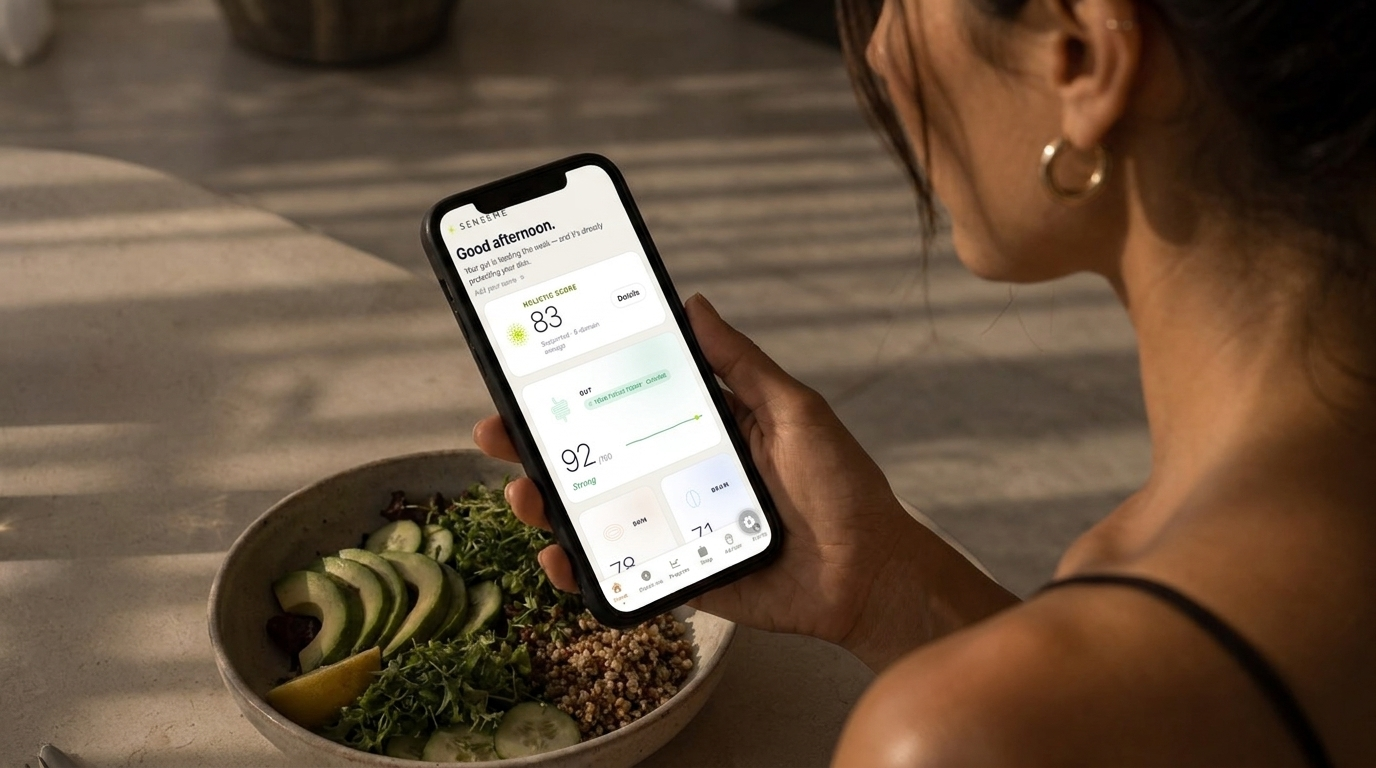
The SenseMe app includes a Gut domain score that integrates these biological signals into a trackable daily index. One of the more counterintuitive findings from gut-skin research is the existence of a gut-skin lag of approximately 48 hours: shifts in gut microbial balance — including changes in Bifidobacterium spp. or F. prausnitzii levels — can precede visible skin score changes by one to two days. Without structured longitudinal tracking, this lag is nearly invisible; the brain instinctively pairs skin outcomes with the most recent event, not the cause that occurred two days earlier. SenseMe is built to make that lag visible in personal data — so that interventions like a Livaux supplementation trial can be evaluated against biological signals that actually reflect the mechanism, not just subjective symptom recall.
To be clear about claims language: consistent Livaux supplementation may support gut microbiome diversity; increased F. prausnitzii abundance is linked to better gut barrier function in the research literature; a healthier gut barrier can contribute to lower systemic inflammatory load. None of this constitutes a claim that Livaux treats, cures, or prevents any skin condition or disease. SenseMe itself does not diagnose or treat; it monitors and makes patterns visible.
Common Questions


- Blatchford P, Stoklosinski H, Eady S, et al. Consumption of kiwifruit capsules increases Faecalibacterium prausnitzii abundance in functionally constipated individuals: a randomised controlled human trial. J Nutr Sci. 2017;6:e52. doi:10.1017/jns.2017.41.
- Sokol H, Pigneur B, Watterlot L, et al. Faecalibacterium prausnitzii is an anti-inflammatory commensal bacterium identified by gut microbiota analysis of Crohn disease patients. Proc Natl Acad Sci USA. 2008;105(43):16731–16736. doi:10.1073/pnas.0804812105. PMID 18936492.
- Corrêa-Oliveira R, Fachi JL, Vieira A, Sato FT, Vinolo MA. Regulation of immune cell function by short-chain fatty acids. Clin Transl Immunol. 2016;5(4):e73. doi:10.1038/cti.2016.17. PMID 27195116.
- Cani PD, Amar J, Iglesias MA, et al. Metabolic endotoxemia initiates obesity and insulin resistance. Diabetes. 2007;56(7):1761–1772. doi:10.2337/db06-1491. PMID 17456850.